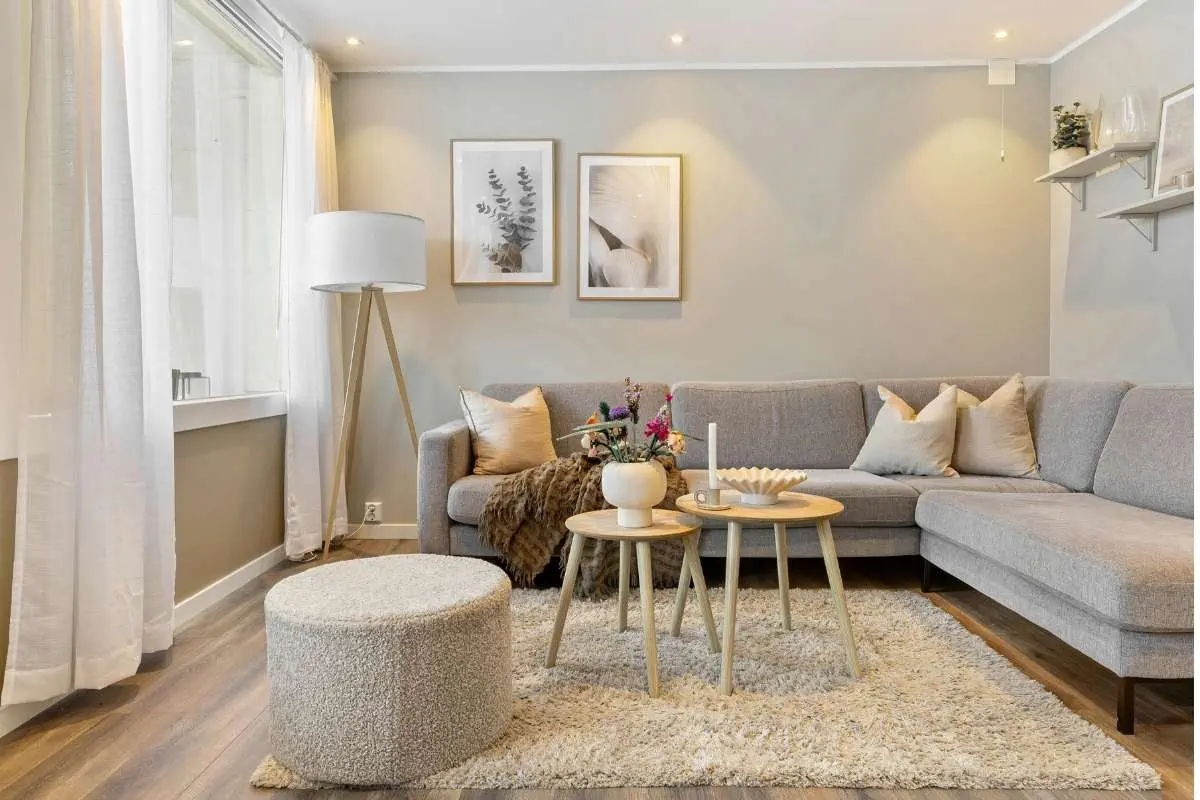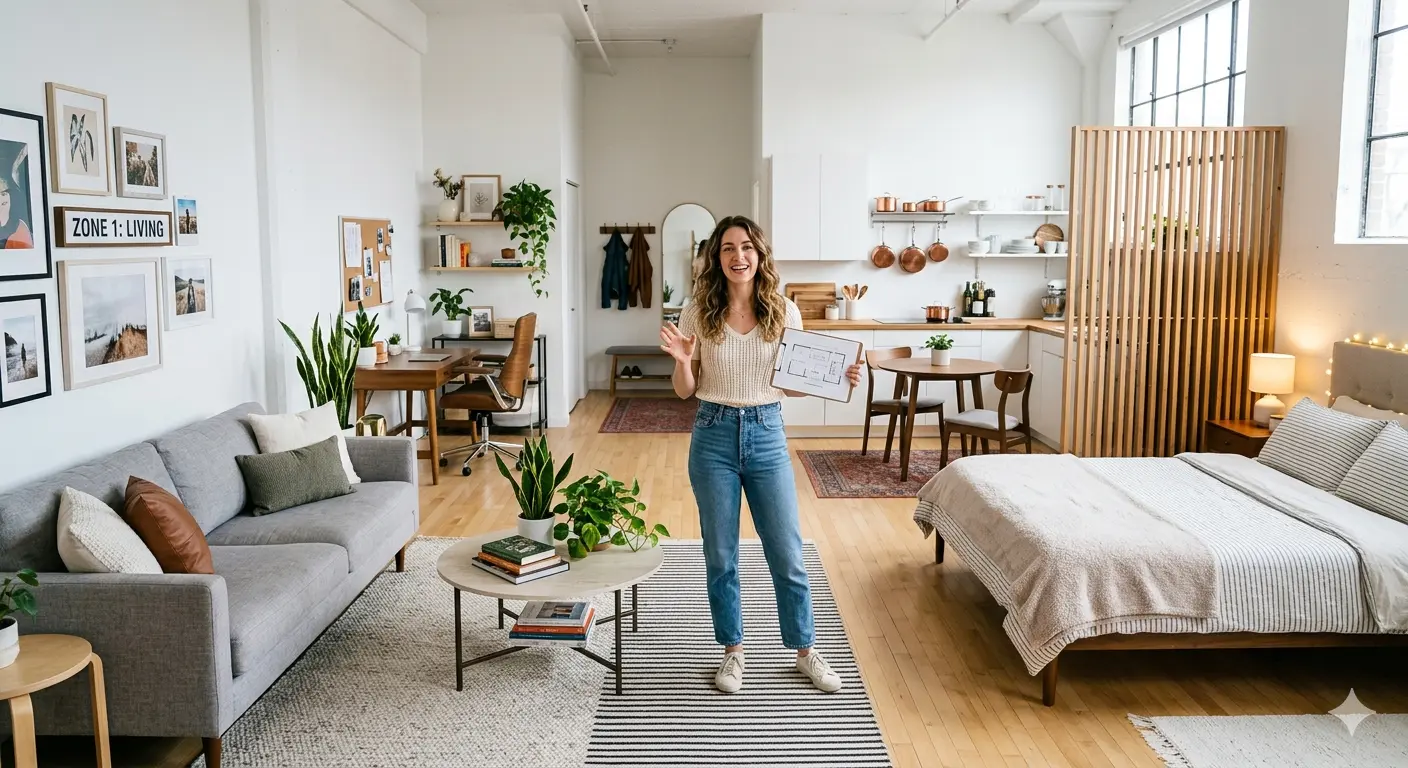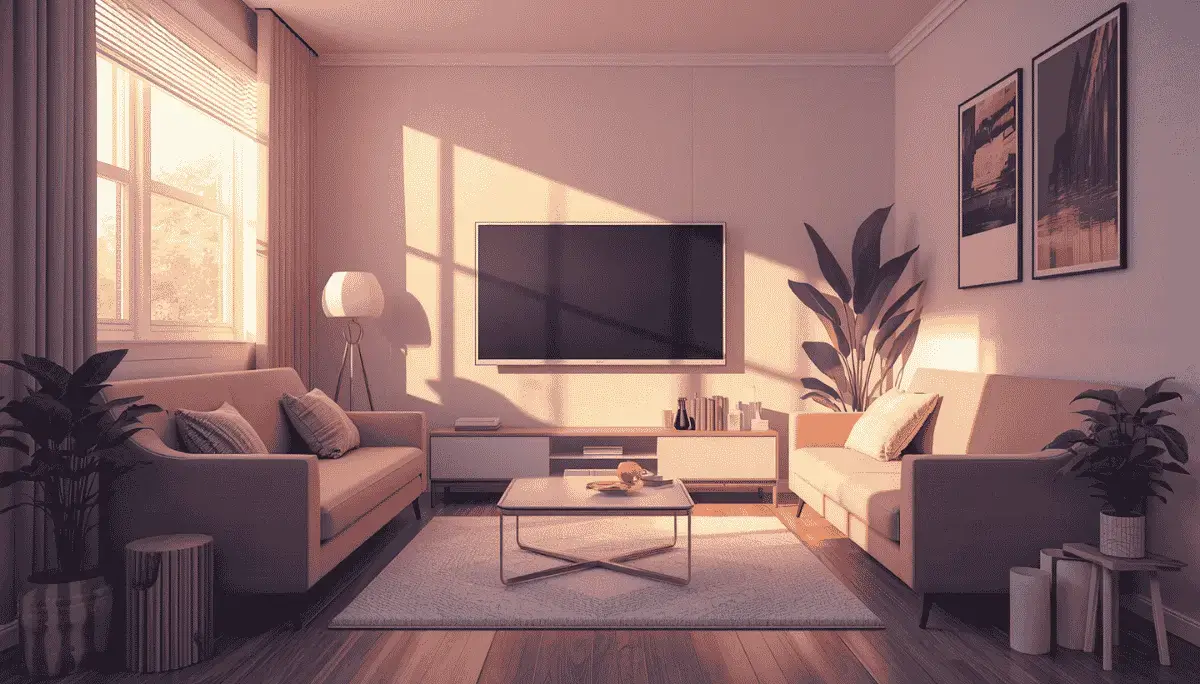
Positioning a TV in a small room requires balancing visual weight and floor space. Mounting the television at eye level (around 42 inches from the floor) or placing it over a low-profile console prevents the screen from overwhelming tight seating arrangements.
A small living room with a TV does not have to feel like a furniture showroom crammed into a closet. The real problem is not the room size; it is that most sofa-and-TV advice online is written for houses, not rental apartments where you can not drill into a wall or paint over a security deposit.
This guide covers small living room ideas with TV placement that work for actual apartments: a sizing chart so you stop guessing, layouts sorted by exact room dimensions, no-drill mounting options that would not cost your deposit, and a real cost breakdown.
What Size TV Fits a Small Living Room?
The right TV size depends on how far your sofa sits from the screen, not how wide your wall is. Go too big for the distance, and you will strain your eyes; go too small, and the TV disappears into the wall.
TV Size to Viewing Distance Chart
| TV Size | Minimum Distance | Ideal Viewing Distance | Best Layout Setup |
|---|---|---|---|
| 32-inch | 4 feet | 4–5 feet | Compact media console or corner shelf |
| 43-inch | 5.5 feet | 6 feet | Low-profile TV stand or floating unit |
| 50-inch | 6 feet | 7 feet | Wall-mounted on primary focal wall |
| 55-inch | 7 feet | 8–10 feet | Flush wall mount above a low console |
| 65-inch | 8 feet | 9–10 feet | Main feature wall in longer living rooms |
A simple rule of thumb: sit about 1.5 times the screen diagonal size away from it; see Sony official viewing distance guidance. If your sofa is 8 feet from the wall, a 55-inch TV is the largest you should comfortably go.
For most apartment living rooms under 200 square feet, a 43- to 50-inch TV stays proportional to the wall and matches a sofa placed 6–7 feet away.
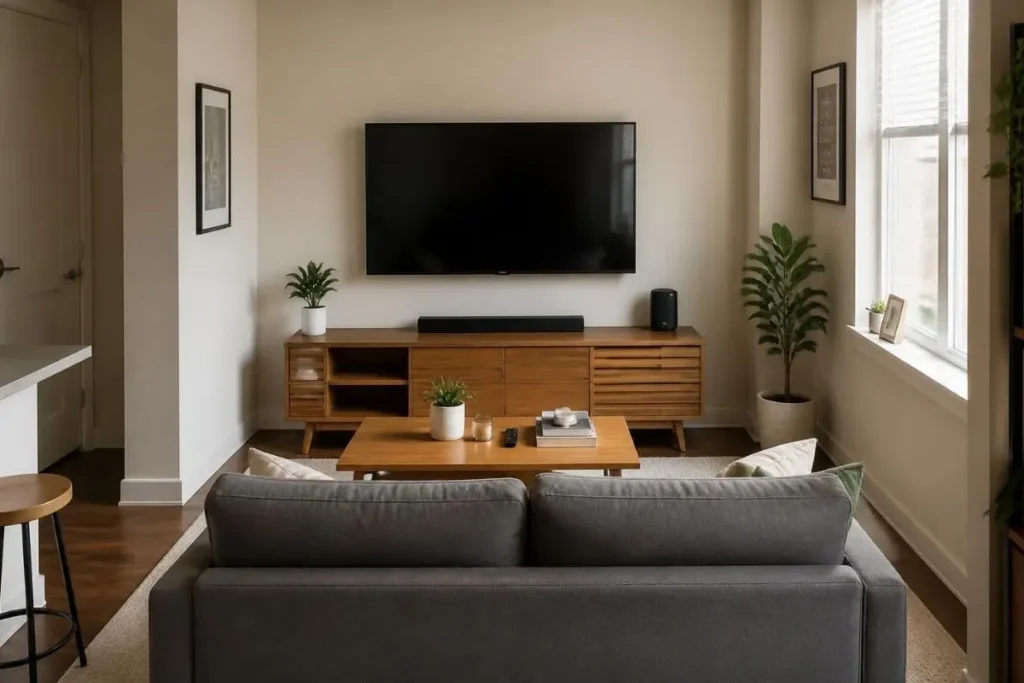
Small Living Room Layouts by Room Size
- 10×10 room (100 sq ft):
- Ideal with a seat and a 32–40 inch TV placed at a distance of 4.5–5 feet; leave out the coffee table.
- 10×12 room (120 sq ft):
- A 3-seater sofa and a 43-inch TV fit in a 6-foot direct-facing layout.
- 10×15 room (150 sq ft):
- The most flexible size; supports a corner layout with a 50-inch TV placed 7 feet away and an L-shaped sofa.
Generic “arrange your furniture” advice does not help when your actual room is 10×10 or 10×15 feet. Here is how the TV-sofa relationship changes at each size.
10×10 Room (100 sq ft)
This is tight enough that every extra inch matters. Skip a TV stand entirely; a wall-mounted or adhesive-strip floating shelf under the TV keeps the floor clear. Use a loveseat or a two-seater sofa placed against the longest wall, 4.5–5 feet from a 32–40-inch TV. Skip the coffee table or use a small ottoman instead; a full coffee table in a 10×10 room usually blocks the walking path.
10×12 Room (120 sq ft)
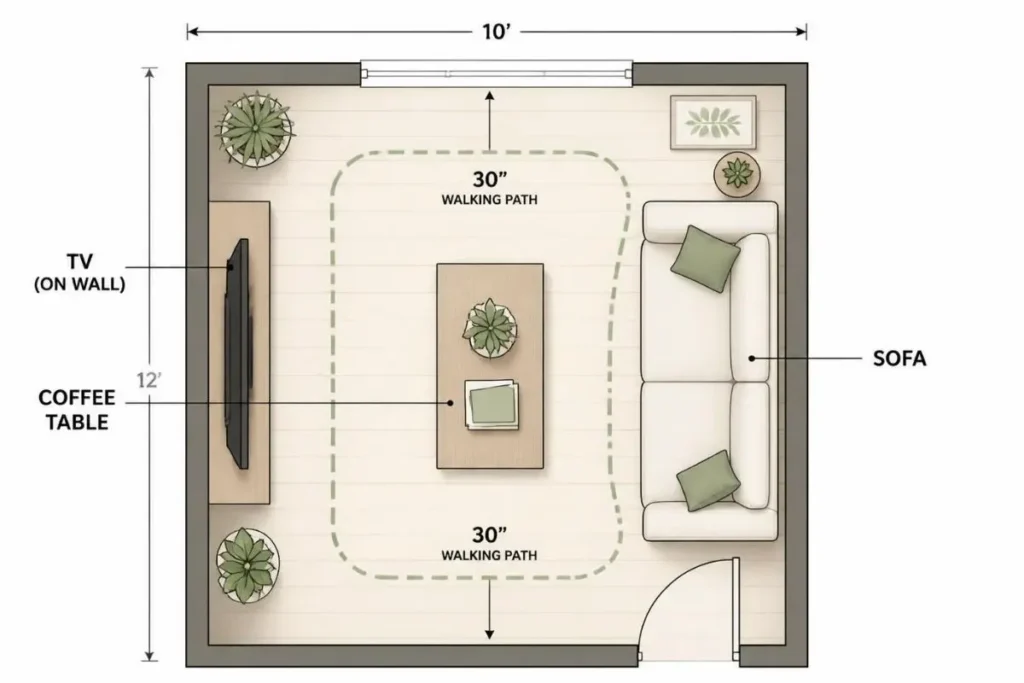
Enough space for a proper 3-seat sofa and a 43-inch TV at 6 feet. This is the size where a direct-facing layout (sofa on one wall, TV directly opposite) works best without feeling cramped. Leave 30 inches for the main walkway and 18 inches between the sofa and any coffee table.
“I have arranged the living room of my apartment using this exact 10×12 layout — a sofa on one wall, directly opposite the TV, and it has remained comfortable and clutter-free for over a year without any wall marks.”
— Ayesha, Webpluse
10×15 Room (150 sq ft)
The most flexible small living room size. You can run a corner layout: a sofa along the 15-foot wall and a TV mounted in the adjacent corner, which frees the center of the room for a coffee table and a rug. A 50-inch TV works comfortably here at 7 feet. This size also fits an L-shaped sofa tucked into a corner without blocking the room main traffic path.
15 Small Living Room Ideas with TV (Renter-Friendly)
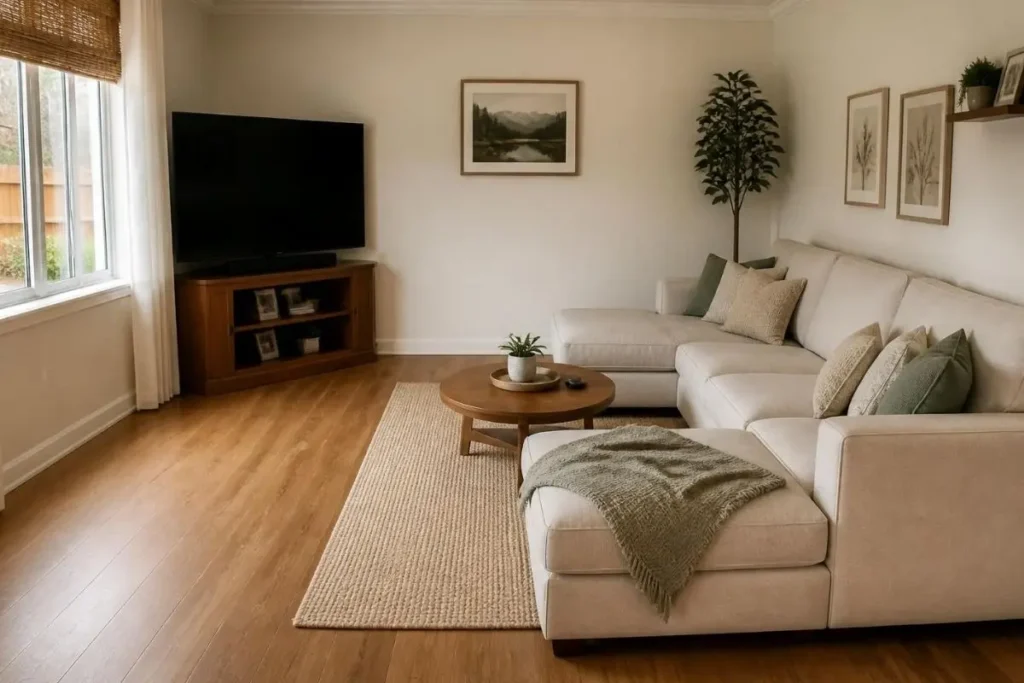
1. Use a no-drill floating TV shelf.
Instead of a wall-mounted bracket (which most leases do not allow), use a floating shelf secured with heavy-duty adhesive strips rated for the TV weight. It gives the same floating-wall look without a single hole.
2. Try a corner TV stand.
A corner stand angles the screen toward the seating area and turns an unused corner into a working media zone; no drilling is required since it is freestanding furniture.
3. Use a TV cart on wheels.
A rolling TV cart is the most rental-friendly option on this list. It gives you the floating, minimal look of a mounted TV, but you can move it, take it with you, and leave zero marks at move-out.
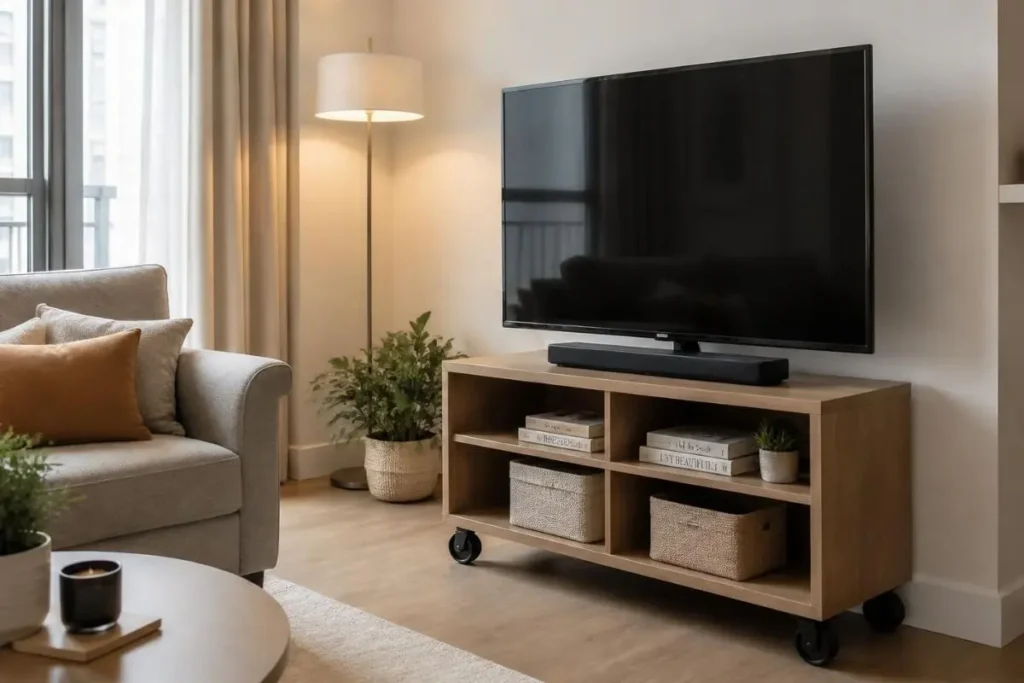
4. Choose a seat over a Full Sofa
A seat or compact two-seater keeps the seating area proportional to a small room and preserves the viewing distance a full sofa would eat into.
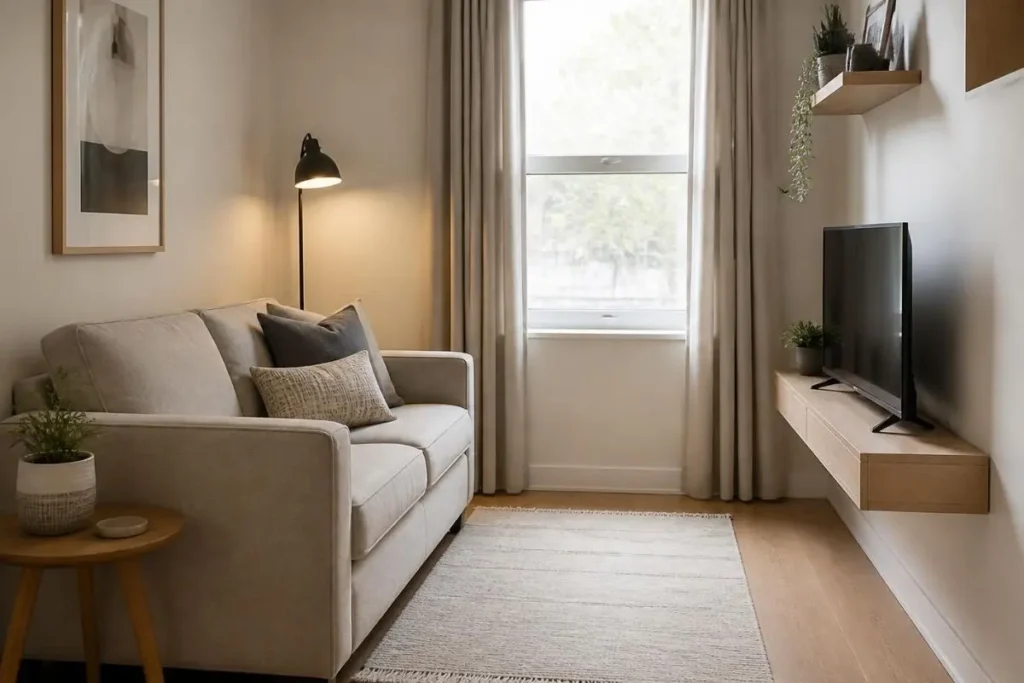
5. Try an L-shaped sofa with a low back.
A low-back L-shaped sofa fits into a corner, faces the TV directly, and does not block sightlines the way a full sectional does.
6. Add a swivel TV mount (no-drill version).
Freestanding swivel TV stands exist specifically so you do not need a wall mount. One TV can then serve two seating zones in an open layout.
7. Hide the TV with a tension-rod curtain panel.
A tension rod mounted just above the TV (no drilling into the wall) with a slim curtain panel lets you cover the screen when it is off, without committing to sliding cabinet doors.
8. Use Leggy, Raised Furniture
Furniture on visible legs lets light pass underneath, which makes the floor feel larger — this works for both the sofa and any TV console.
9. Place the Sofa on the Longest Wall
Anchoring the sofa on the longest wall and the TV on the opposite or adjacent wall is the most space-efficient layout in a rectangular apartment room.
10. Add a Removable Wallpaper Accent Wall Behind the TV
Peel-and-stick wallpaper or a large piece of renter-safe removable fabric behind the TV turns the screen into a designed focal point, and it comes off clean at move-out.
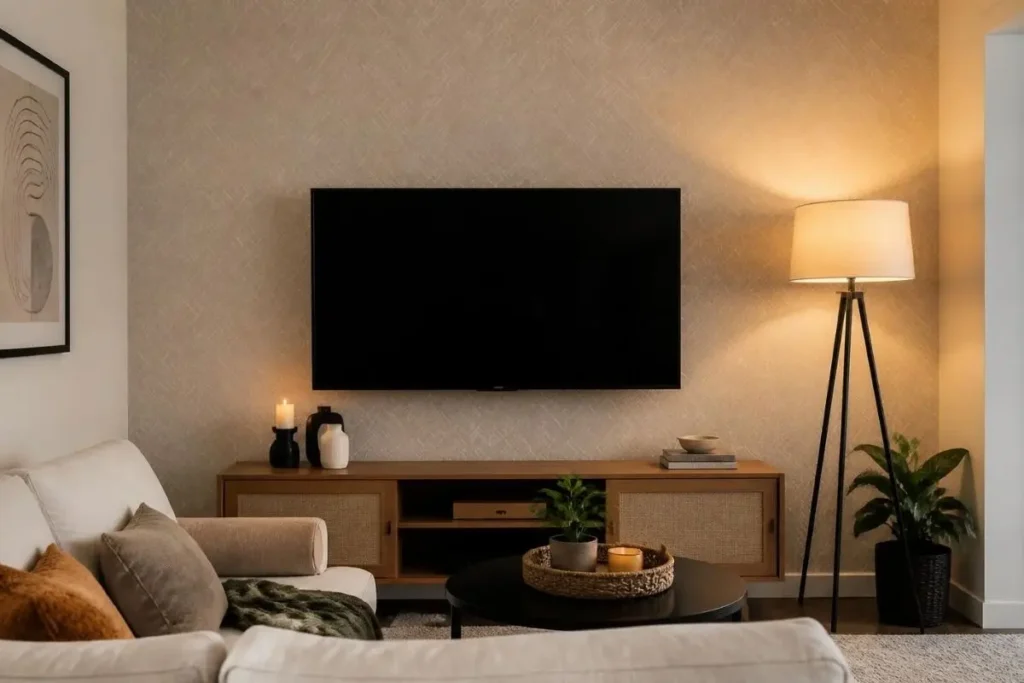
11. Use Multi-Functional Furniture
An ottoman with hidden storage or a lift-top coffee table adds function without visual bulk, useful in any of the room sizes above.
An ottoman with hidden storage or a lift-top coffee table adds function without visual bulk; for more storage-smart picks, check our small apartment storage ideas guide.
12. Zone an Open Floor Plan with a Rug
In a studio or open-plan apartment, a rug under the sofa and TV area visually separates the living zone from the kitchen without a permanent wall.
13. Surround the TV with freestanding bookshelves.
Two matching freestanding bookshelves flanking the TV blend the screen into the wall and add storage; again, no wall mounting needed.
14. Layer the lighting.
Light wall colors (or a light-colored renter-safe paint if your lease allows it), one solid-color sofa, and minimal decor keep a small room from feeling visually noisy.
15. Common Mistakes to Avoid
- Buying the sofa before measuring the 30-inch walking path
- Choosing a TV too large for the seating distance
- Drilling a wall mount without checking your lease is against the damage policy
- Blocking natural light with a bulky entertainment console
- Ignoring cord management, which makes any layout look cluttered
- Centering the TV on the wall instead of on the seating line; these are not always the same point
Quick takeaway: the fastest way to upgrade a small living room is to free the floor (floating or corner TV stand) and free the walls (light colors, built-in shelving) at the same time.
Cost Breakdown: No-Drill TV Setup for a Small Apartment
In rooms under 150 square feet, fitting a sofa and TV together comes down to choosing a single layout rather than mixing several.
| Item | Budget Option | Mid-Range Option |
|---|---|---|
| TV cart on wheels | $35–$60 | $90–$150 |
| Heavy-duty adhesive floating shelf | $20–$35 | $45–$70 |
| Tension rod + curtain panel | $15–$25 | $40–$60 |
| Peel-and-stick wallpaper (accent wall) | $25–$40 | $60–$100 |
| Plug-in wall sconces (pair) | $30–$50 | $70–$120 |
| Total | $125–$210 | $305–$500 |
For a full room-by-room budget breakdown beyond just the TV setup, see our apartment decorating cost breakdown guide.
FAQs About Small Living Room Ideas with TV
Is it OK to put a sofa in front of a window?
Yes. A low-back sofa in front of a window works well in a small living room as long as it does not block the window from opening and the window treatment can still close for glare during TV viewing.
Does the sofa need to be centered with the TV?
No. The sofa should align with your main seating line, and the TV should be mounted at that eye level and centered to the seating, not necessarily centered on the wall itself, especially if the wall is asymmetrical.
Where should the TV go in a small living room?
On the wall opposite or adjacent to the longest seating wall, at a distance matching the TV size chart above. In a corner-shaped room, a corner mount usually works best.
Can you put a TV stand in front of a window?
It is possible, but glare during the day can make the screen hard to see. If it is the only option, use blackout curtains or a tension-rod panel to control light during viewing hours.
How far should a sofa be from the TV in a small room?
At least 5.5 feet from a 43-inch TV, up to 8–10 feet from a 55-inch TV, based on the 1.5x-diagonal viewing distance rule.
Does light grey make a small room look bigger?
Yes. Light grey, along with white and beige, reflects more light than dark tones, which makes walls feel like they recede rather than close in. Benjamin Moore color experts confirm a well-documented small-space technique.
Can a small living room fit both a sofa and a TV?
Yes, comfortably, in rooms as small as 100 square feet when the sofa is sized to the room (a loveseat or two-seater) and the TV size matches the viewing distance.
Related Blogs:
- What Are the Best One-Bedroom Apartment Decorating Ideas on a Budget?
- Latest Home Improvement Tips: Is It Actually Possible to Renovate on a Tight Budget?
A small living room becomes functional the moment the sofa and TV layout is planned around actual measurements rather than guesswork. Start with one focal wall, protect the walking path, and choose a TV size that matches the actual viewing distance.
Browse more of our small-space guides for additional layout inspiration, including how to decorate your apartment on a budget and smart apartment decorating ideas for every room in your home.

Ayesha Khan is a home stylist and interior layout strategist and the founder of Webpluse. She specializes in transforming compact residential spaces through practical apartment decorating ideas, high-density storage solutions, and budget-friendly home improvement strategies—all tested in her own rental apartments. Her guides help a global audience across the United States, France, and Germany furnish and style small spaces without overspending.