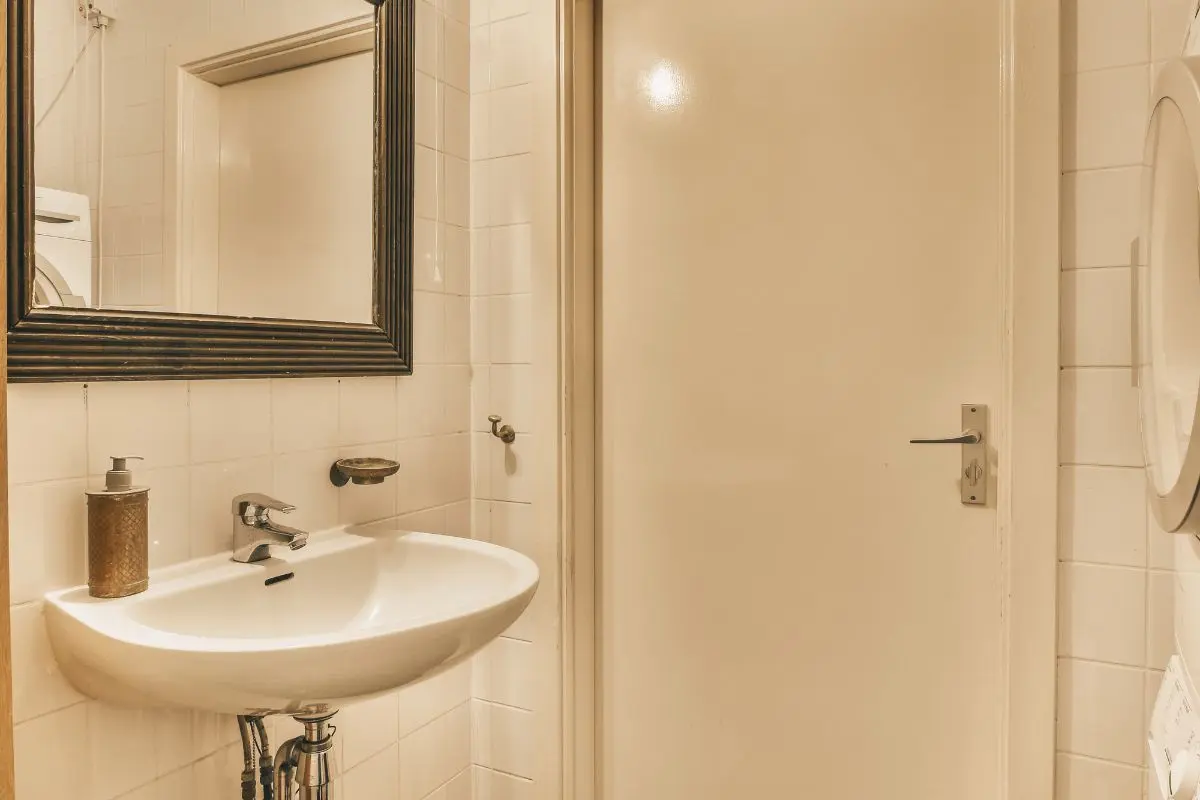
A small apartment bathroom requires using vertical space above current fixtures to add additional storage. Installing over-the-toilet space savers, adhesive shower caddies, and under-sink tiered organizers provides maximum storage capacity without permanent modifications.
If you are looking for the best extra bathroom storage for apartments, you are in the right place. A lot of no-drill bathroom storage advice is not quite honest with you. Half the floating shelves and wall cabinets recommended as renter-friendly still need a bracket screwed into the wall; the shelf itself just clips on afterward, which is where the no-tools claim quietly starts to fall apart.
So before getting into the ideas themselves, it is worth sorting them into two piles: things that genuinely touch nothing but adhesive or pressure, and things that need at least one small hole somewhere in the process. Only the first pile belongs in an apartment bathroom without a conversation with your landlord first.
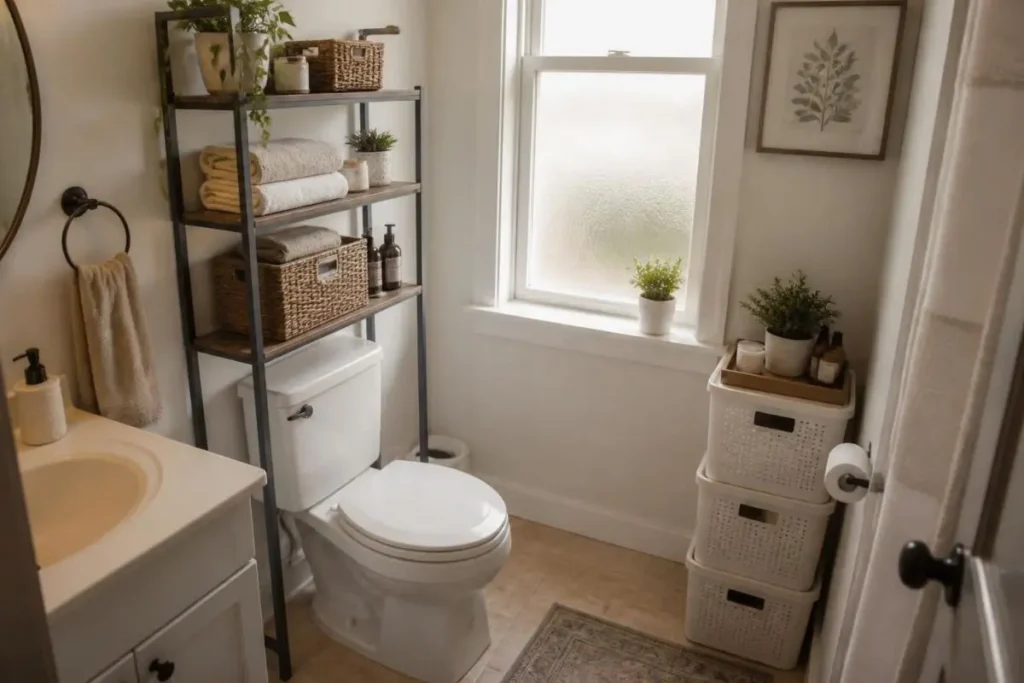
Non-Permanent Bathroom Storage Ideas for Apartment Renters
What Actually Counts as No-Drill Bathroom Storage?
Anything that stays up using weight, tension, or adhesive, not screws, brackets, or wall anchors, even small ones.
- Genuinely no-drill: tension rods, suction-mounted caddies, weight-rated adhesive hooks, freestanding carts, over-the-door racks.
- Often mislabeled as no-drill: most “floating shelves” (the shelf clips onto a wall-mounted bracket, which usually needs screws), some wall cabinets marketed as “easy install”.
If a product page says “easy installation” without specifying adhesive-only mounting, assume it needs a drill until you confirm otherwise.
Are Command Strips Actually Safe to Use in a Bathroom?
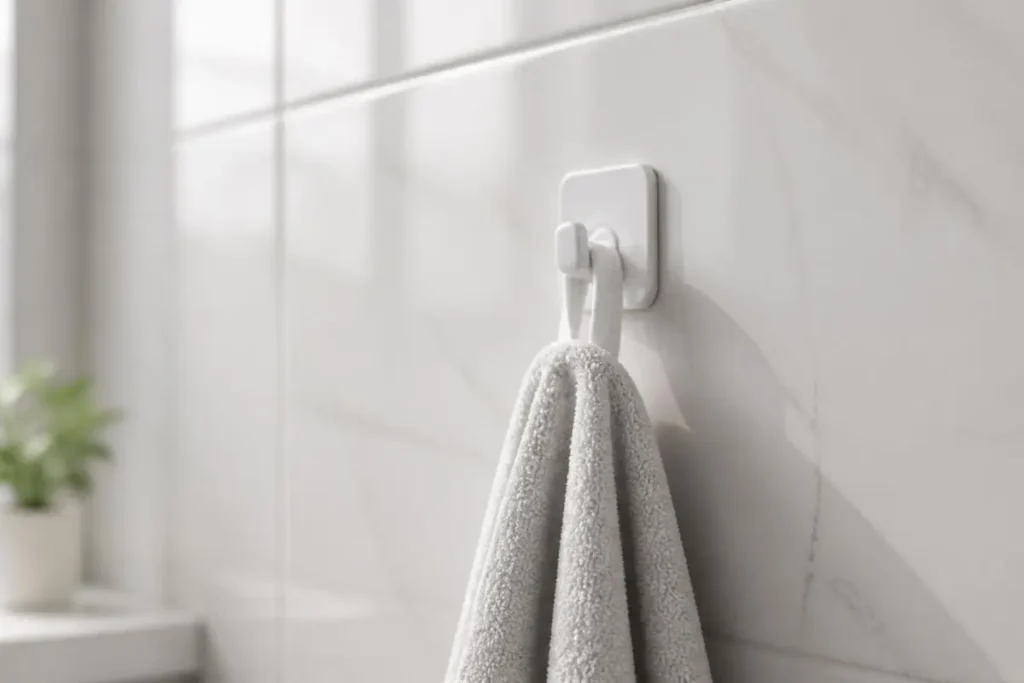
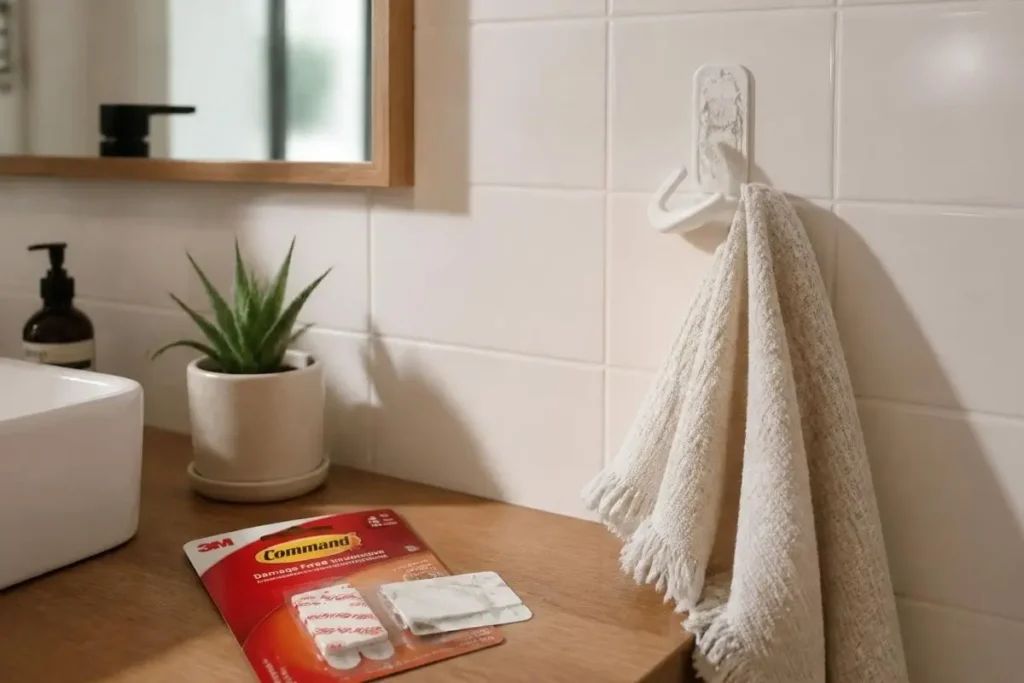
Only if you buy the bathroom-specific line, not the standard indoor strips. Regular Command strips are not built to handle steam and condensation, and they will eventually let go.
The Command Bath line uses a water-resistant adhesive formulated to hold in humid, steamy conditions, and it is rated to hold 3 to 5 pounds per strip, according to product specifications from the 3M Command brand. Standard strips used in a bathroom will likely fail faster, even if the item itself is light; the moisture breaks down the bond, not the weight.
A few things worth knowing before you hang anything:
- Buy for roughly half the stated weight limit if your bathroom runs especially steamy.
- Wait at least 24 hours after mounting before hanging anything on the strip, so the adhesive fully sets.
- Once an item is heavier than about 16–20 pounds, adhesive generally is not the right tool anymore; that is when a freestanding option makes more sense than trying to push a wall strip past its limit.
What is the Best No-Drill Storage for Over the Toilet?
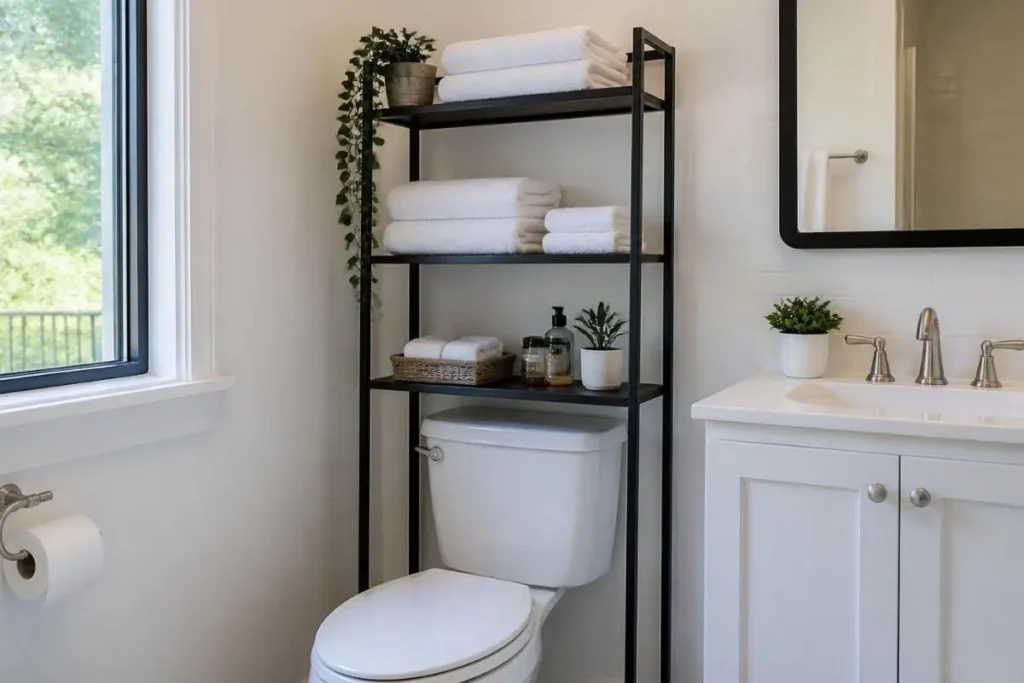
A freestanding shelf unit, not a wall-mounted one. This is the single most searched bathroom storage need, and it is also where the “fake no-drill” problem shows up most often.
A true freestanding over-the-toilet unit has its own legs and straddles the toilet tank without touching the wall at all. It holds considerably more than an adhesive shelf could, and it comes with you when you move.
If you specifically want something wall-adjacent rather than floor-standing, an over-the-tank shelf with rubber feet (not screws) that simply rests on the tank lid works well for lightweight items; just do not confuse it with a wall-mounted version, which is a different product entirely. The same freestanding logic applies well beyond the bathroom, too. Our guide to small apartment storage ideas covers the same principle for the rest of the apartment.
How Do I Add Storage Under the Sink Without Built-In Cabinets?
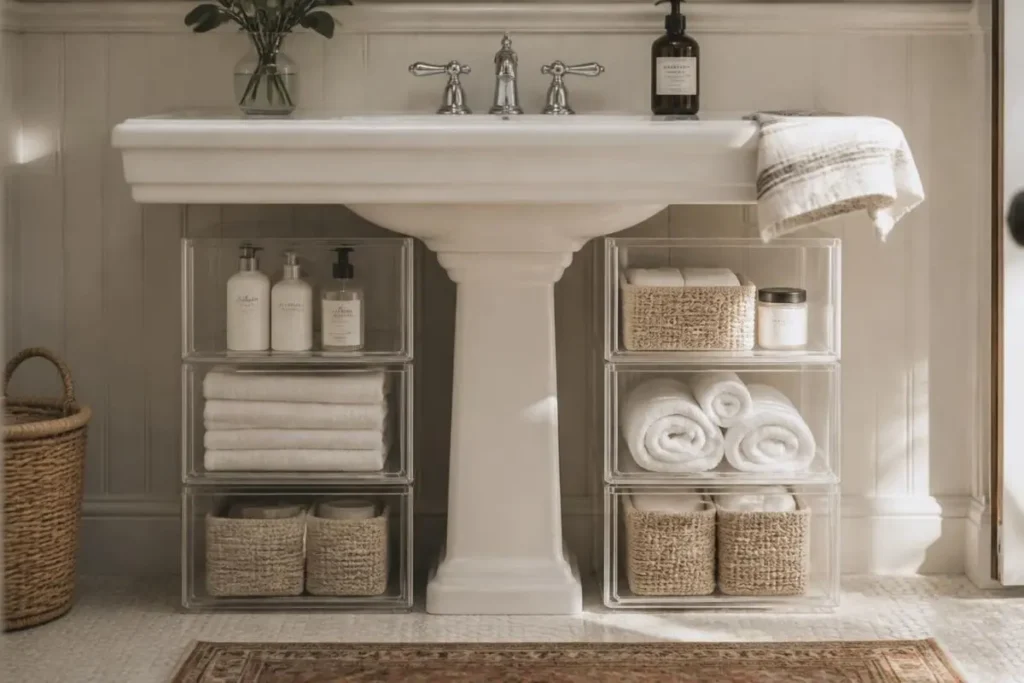
Stackable bins and a pull-out organizer usually solve this better than anything wall-mounted. Pedestal sinks and open vanities are one of the most common small-apartment bathroom complaints, and the fix has nothing to do with the wall.
- Clear stackable bins let you see what is inside without opening every container.
- A slim rolling cart tucked beside the sink adds storage the room technically does not have.
- For pedestal sinks specifically, a narrow console table or slim shelving unit fills the dead space on either side.
If drawer space is the actual bottleneck rather than cabinet space, the dividers and labeling system covered in Small Closet Organization Ideas for Renters works just as well in a bathroom vanity drawer as it does in a closet.
What Goes on the Back of the Bathroom Door?
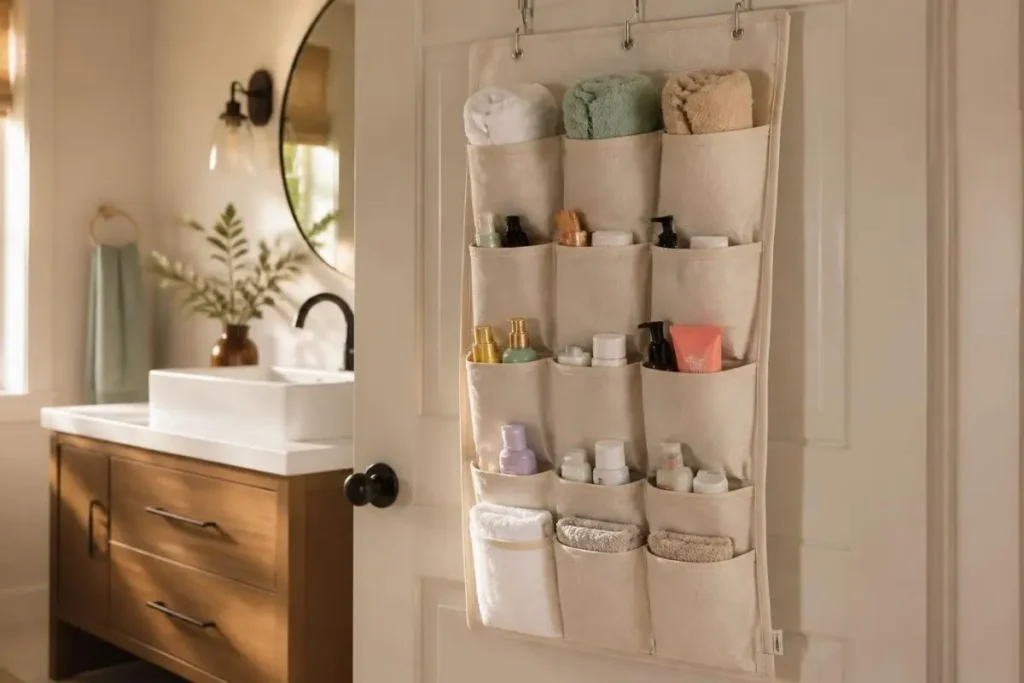
More than most people use it for. The back of a bathroom door is one of the few genuinely wasted spaces in a small apartment bathroom, and it is entirely drill-free with the right hardware.
An over-the-door organizer hangs on the door itself using a bracket that hooks over the top; no hardware touches the door or the frame. This works for towels, hair tools, or a hanging shower caddy that is not currently in the shower.
Is a Bathroom Cart Actually Worth Buying?
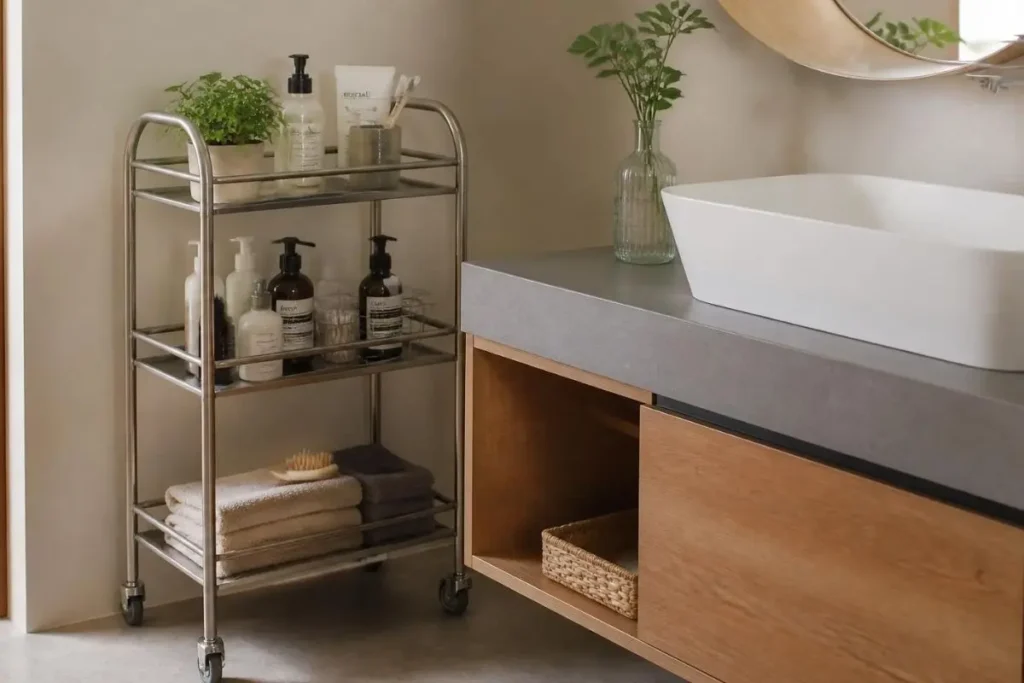
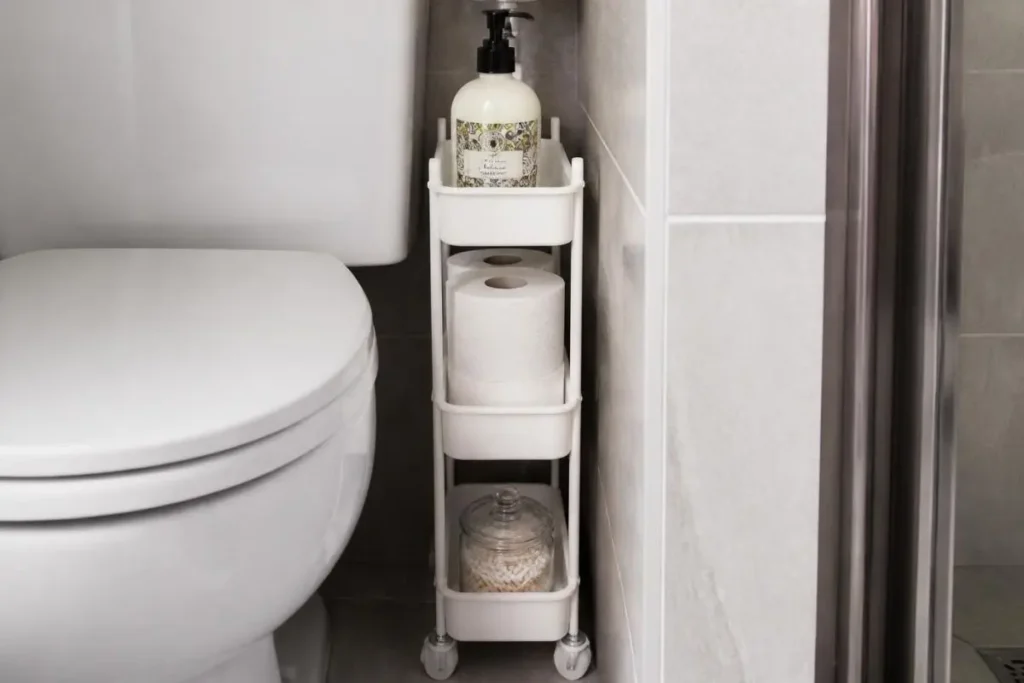
If your bathroom has even a narrow gap of floor space, yes, a rolling cart often replaces what a built-in cabinet would have done, without needing one.
A three-tier cart lets you separate categories instead of piling everything into one basket: daily items on top, backups in the middle, cleaning supplies on the bottom, or whatever makes sense for your routine. It also rolls out of the way when you need the floor space for something else, which a fixed shelf can not do.
How Much Does a No-Drill Bathroom Storage Setup Cost?
Less than one piece of built-in cabinetry would. A reasonably complete setup, an over-the-toilet unit, an over-the-door organizer, a few stackable bins, and a set of Command Bath hooks typically run in a fairly narrow range.
| Storage Unit | Typical Cost | Storage Benefit | Rental Friendly |
|---|---|---|---|
| Freestanding Over-the-Toilet Unit: | $35–$70 | Maximizes vertical space over toilet for towels & jars. | Yes (100% Damage-free) |
| Over-the-Door Organizer: | $15–$30 | Hangs over bathroom door for toilet paper & toiletries. | Yes (No tools needed) |
| Stackable Under-Sink Bins (Set): | $15–$25 | Keeps cleaning supplies and personal care items organized. | Yes (Freestanding) |
| Command Bath Hooks (Set of 3–4): | $10–$15 | Water-resistant hanging for robes, loofahs, and towels. | Yes (Adhesive) |
| Rolling Cart (Optional): | $25–$45 | Movable multi-tier storage for tight floor spaces. | Yes |
| Full Setup Total: | $100–$185 | Complete budget-friendly rental bathroom organization. | |
Compare that to installing even a basic built-in cabinet, which typically starts well above $200 once materials and labor are factored in, and a built-in does not come with you when the lease ends.
Which Setup Fits Your Bathroom?
The right combination depends on what your specific bathroom is missing, not on buying everything at once.
| Your situation: | Start here: |
|---|---|
| No cabinet, just a pedestal sink. | Slim console or rolling cart beside the sink. |
| Small bathroom, no linen closet. | Freestanding over-the-toilet unit. |
| Shared bathroom, need separated storage. | Stackable bins with labels, one set per person. |
| Only a mirror, no medicine cabinet. | Over-the-door organizer instead of trying to add a cabinet. |
| Deep but narrow gaps beside fixtures. | A slim rolling cart sized to the gap. |
I broke down my full system here: 6 Ways to Organize a Small Bathroom With No Cabinet Space.
Does This Actually Protect a Security Deposit?
Yes, and it is worth taking seriously if you have hung anything in a bathroom before. Guidance on move-out charges compiled by RentSpree notes that while small nail holes are typically treated as normal wear and tear, larger holes, including the kind needed for a wall-mounted shelf bracket, can be billed back to the tenant as damage.
That is why the “genuinely no-drill vs. technically needs a bracket” distinction matters here more than it might in a bedroom. Bathroom walls are often tile, which makes drilling both harder to do cleanly and more expensive to patch if it goes wrong.
Does Shower Storage Follow the Same Rules?
Mostly yes, but with one extra consideration: standing water. A shower caddy that hangs over the showerhead avoids adhesive altogether, which sidesteps the humidity problem entirely.
- Over-the-showerhead caddies hang by their own weight; no adhesive or drilling involved.
- Suction-cup caddies work on smooth tile but tend to lose grip over time in constant steam; check and re-press them periodically rather than assuming they are permanent.
- Tension-pole caddies wedge between the shower floor and ceiling, which holds considerably more weight than adhesive ever could.
If your shower has a built-in niche already, none of this applies, but most apartment showers do not, which is where these three options tend to matter most.
A Few Mistakes Worth Avoiding:
A handful of small missteps account for most of the “why did this fall” moments in a rented bathroom.
- Using standard Command Strips instead of the Bath line is the single most common mistake, since the packaging looks nearly identical.
- Mounting anything within a few inches of a shower or bath spray zone, even water-resistant adhesive, struggles with direct, repeated splashing.
- Overloading one strip instead of stepping up to a larger size: ratings are not additive, so doubling up small strips does not equal one bigger one.
- Skipping the cure time: hanging something immediately after mounting a strip is the fastest way to have it peel off within a day.
None of these mistakes are expensive to fix, but they are the difference between a setup that lasts through the lease and one that needs redoing every few months.
What Are Some Smart Hidden Storage Ideas for a Bathroom?
The most overlooked storage in a small bathroom usually is not missing; it is just being used for something else or not being used at all.
- Inside a cabinet door: a slim adhesive rack on the inside of a vanity door holds small items without taking up shelf space.
- Behind a mirror: Swapping a flat mirror for a shallow medicine cabinet turns wasted wall space into storage without changing the footprint.
- The gap beside the toilet: often just wide enough for a narrow rolling cart, even in bathrooms that feel completely maxed out.
- Inside a bath towel—literally: some over-the-door organizers roll flat when empty, so they do not add visual clutter even when they are holding a lot.
None of these require rethinking the whole room. They just require noticing space that is currently doing nothing.
What Should not Be Stored in a Bathroom?
A few common bathroom items do not actually belong there, mostly because of humidity rather than space.
- Medications: heat and moisture can degrade many medications faster than their labels account for; a bedroom drawer or hallway closet is usually a better spot.
- Electronics that are not rated for steam: tools are fine when unplugged and dry, but anything with exposed circuitry should not sit in a constantly humid room long-term.
- Paper products stored loosely: toilet paper and tissues absorb ambient moisture over time if left uncovered, which is part of why baskets and bins matter more in a bathroom than almost anywhere else in the apartment.
If you are short on space elsewhere in the apartment, moving these categories out of the bathroom often frees up more room than any organizer would.
What Should Go in an Awkward Empty Bathroom Gap?
The narrow, oddly shaped space next to a toilet or beside a vanity is one of the most common “wasted space” complaints in small apartment bathrooms, and it is usually solvable with something built for exactly that gap.
- A slim rolling cart (as narrow as 6–8 inches) fits spaces too tight for almost anything else.
- A tall, narrow freestanding shelf unit works if the gap has height but little width.
- If the gap is genuinely too small for furniture, an adhesive hook strip turns even a few inches of wall into usable storage.
Last words:
Most bathroom storage advice treats “no drilling” as a marketing phrase rather than an actual constraint, which is how so many “renter-friendly” shelves quietly turn out to need a bracket after all. Checking the mounting method before you buy, not just the description, is really the whole trick here.
Start with whichever gap in your bathroom is causing the most daily frustration, whether that is the floor next to the toilet, the space under the sink, or the back of a door that is currently doing nothing. None of the fixes above need a landlords permission, and all of them travel with you on the next move.
You can also find a shorter version of this on Medium and Blogger.
FAQ: Best Extra Bathroom Storage for Apartments
What is the best no-drill storage for a small apartment bathroom?
A freestanding over-the-toilet unit tends to add the most usable storage without touching a wall, since it stands on its own legs rather than mounting to anything.
Are Command strips actually safe to use in a bathroom?
Only the water-resistant Command Bath line, which holds 3–5 pounds per strip in humid conditions. Standard indoor strips are not rated for steam and will likely fail over time.
Do floating shelves count as no-drill storage?
A complete setup, an over-the-toilet unit, a door organizer, bins, and adhesive hooks typically run $100 to $185, compared to $200+ for even a basic built-in cabinet.
Will bathroom storage hooks damage my walls when I move out?
Water-resistant adhesive strips, used correctly and removed slowly, generally do not. Wall anchors or screws used for shelf brackets are more likely to count as damage under a typical lease.
Is shower storage held up by adhesive strips reliable?
Not as reliable as tension-pole or over-the-showerhead caddies, since direct water spray degrades even water-resistant adhesive faster than general bathroom humidity does.
How do I know if a “no-drill” shelf actually needs screws?
Check whether the product description mentions a wall-mounted bracket or anchors anywhere in the installation steps. If it does, the shelf itself may be tool-free, but the mounting is not.
What is a smart hidden storage idea for a small bathroom?
Swapping a flat mirror for a shallow medicine cabinet turns wall space that is already being used for a mirror into extra storage, without changing the rooms footprint.

Ayesha Khan is a home stylist and interior layout strategist and the founder of Webpluse. She specializes in transforming compact residential spaces through practical apartment decorating ideas, high-density storage solutions, and budget-friendly home improvement strategies—all tested in her own rental apartments. Her guides help a global audience across the United States, France, and Germany furnish and style small spaces without overspending.