Are you struggling to figure out where to put microwave in small kitchen with no counter space? Discover practical, renter-friendly, and structurally secure placement ideas designed to quickly free up your primary prep zones.
- Best for Renters: A rolling kitchen cart or multi-tier rack requires zero drilling and provides mobile appliance storage.
- Best for Dead Space: Placing the microwave on top of the refrigerator uses vertical airspace that otherwise collects dust.
- Best for Seamless Looks: Heavy-duty wall-mounted brackets or under-cabinet mounting kits float the appliance, keeping the counter directly beneath it free.
- Best for Built-In Aesthetics: Removing a lower cabinet door creates a sleek hidden cubby below the line of sight.
- Crucial Safety Metric: Always maintain at least 3 inches of clearance at the top and sides, and 1 inch in the rear for proper ventilation, regardless of where the unit is placed.
When counter real estate is non-existent, a standard microwave can immediately paralyze a small kitchen. The key is utilizing vertical walls, dead zones, and mobile furniture. Here are the best ways to place your microwave when you have no counter space.
1. The Rolling Kitchen Cart or Baker’s Rack (Zero-Installation)
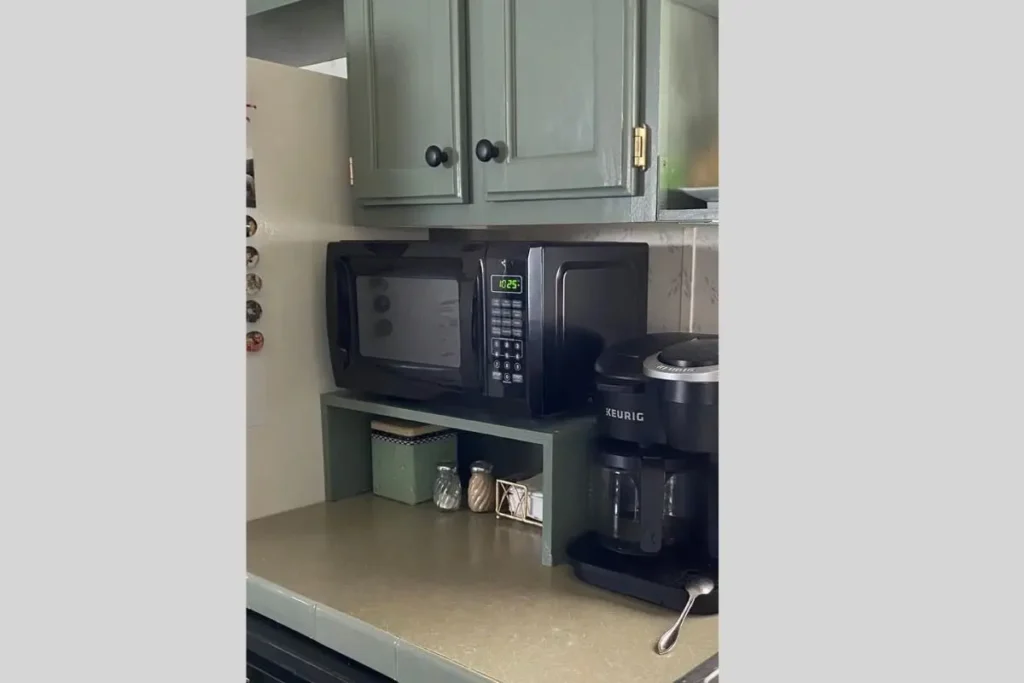
When dealing with tight constraints or walls that cannot support heavy anchors, adaptive furniture is the ideal layout strategy. A rolling utility cart or multi-tiered baker’s rack serves as a secondary, mobile kitchen island.
Why This Works in Small Layouts:
By taking the microwave completely out of the primary work triangle, you isolate the appliance zone. A sturdy cart with locking caster wheels can be tucked against an empty wall, placed at the end of a cabinet run, or even moved into an adjacent dining nook.
Execution & Styling:
Load Capacity: Make sure the upper shelf of the cart is rated for at least 50 to 75 pounds. Microwaves vibrate during operation, so a flimsy wire cart will rattle dangerously. Look for solid wood or heavy-gauge steel tops.
- Vertical Layering: Use the shelves beneath the microwave for complementary storage. Decant your pantry staples into clear jars or store heavy cast-iron pans below to lower the cart’s center of gravity and prevent tipping.
- Electrical Routing: Place the cart within three feet of a grounded wall outlet. Avoid using long, lightweight extension cords, which are fire hazards for high-wattage devices.
When your counter real estate is at zero, solving your appliance setup is just one piece of the puzzle. To make the most of every square inch, you can pair your layout strategy with clever kitchen storage ideas for small apartments to keep your pantry staples and cooking essentials perfectly organized.
2. Heavy-Duty Wall-Mounted Shelving (Vertical Optimization)
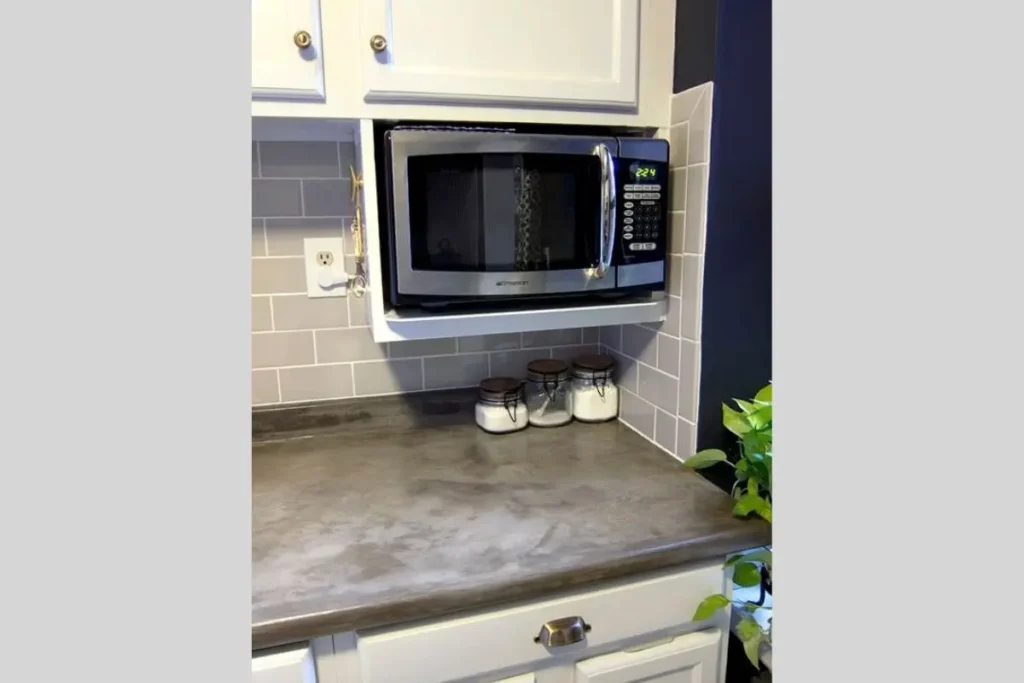
If you have an empty wall but no floor space for a cart, elevating the microwave using wall-mounted brackets is a highly efficient, space-saving storage solution. This method physically removes devices from horizontal surfaces and converts them into floating fixtures.
Structural Requirements & Safety:
Wall-mounting is incredibly effective in terms of space, but it requires strict adherence to safety. A microwave can weigh between 20 and 50 pounds, meaning standard drywall anchors are not enough.
- Stud Mounting: You must use a stud finder to anchor heavy-duty L-brackets directly into wood or metal wall studs.
- Shelf Material: Use a solid piece of hardwood or a reinforced steel shelf. Do not use particleboard or MDF, as these materials will eventually bend under the concentrated weight of the device.
- Ergonomic Height: The ideal mounting height is between 15 and 24 inches above the counter, or roughly shoulder level for the primary user. Mounting it too high creates a severe scald risk when removing hot bowls of liquid.
3. The Over-the-Fridge Setup (Dead Space Utilization)
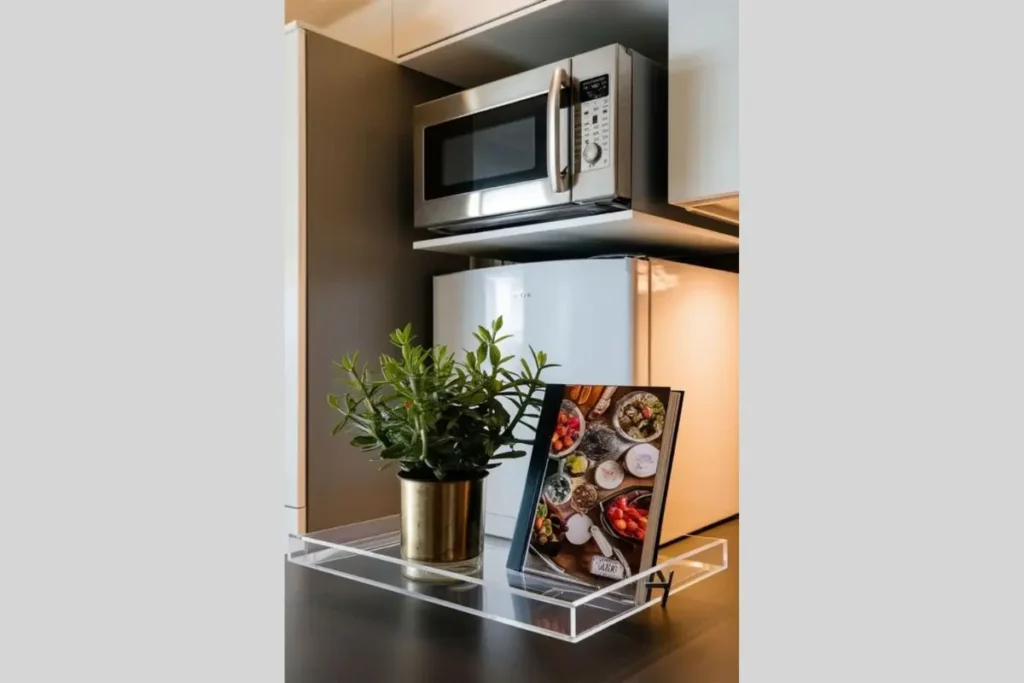
In many apartment layouts, the space directly above the refrigerator is completely wasted. If your refrigerator is standard height (about 65 to 68 inches) and you are tall enough to reach the top comfortably, this is a perfect, zero-cost placement strategy.
Pros and Cons of Fridge Placement:
- The Advantage: It requires zero drilling, zero tools, and immediately removes the appliance from the counter. It centralizes your food storage and reheating into one distinct zone.
- The Drawback: It is not ergonomically viable for shorter individuals or children. Removing hot food from above shoulder height can be dangerous.
Ventilation Protocol for the Fridge Method:
Both the refrigerator and the microwave generate heat. The refrigerator exhausts warm air upward, and the microwave vents air from its sides and back. You should place a solid wooden cutting board or a heat-resistant silicone mat between the top of the refrigerator and the microwave. Furthermore, make sure there is at least 4 inches of open airspace between the top of the microwave and the ceiling or upper cabinet.
4. Under-Cabinet Mounting Kits (The Floating Aesthetic)
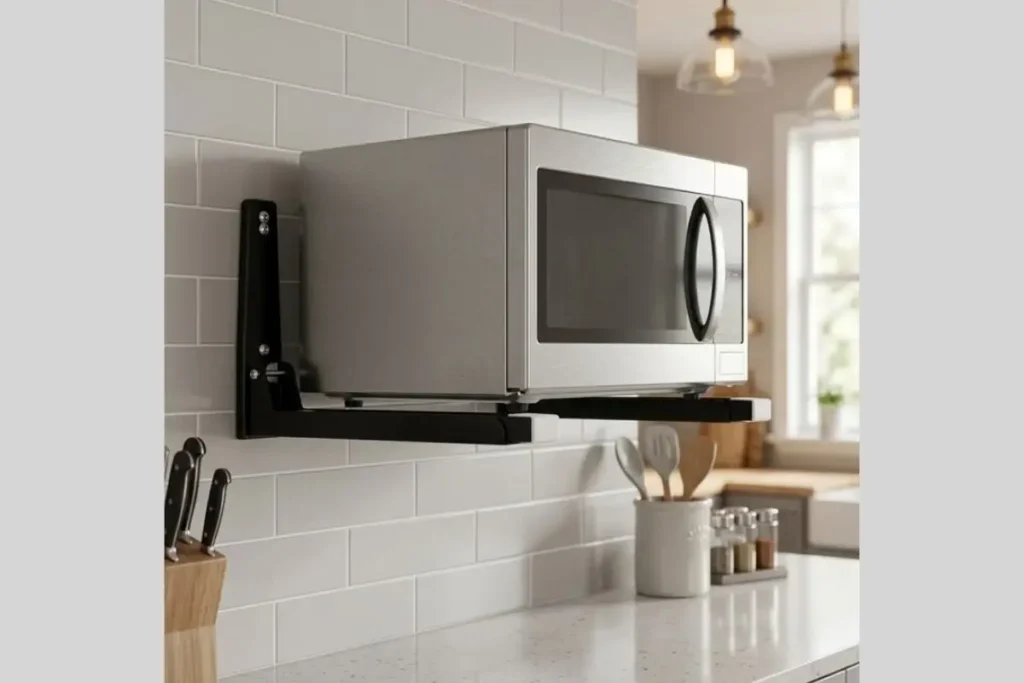
Suspending a compact microwave directly underneath upper cabinetry creates a clean, floating aesthetic that leaves counters completely clear.
- Hanging Brackets: Use compatible hanging kits that bolt down through the floor of your upper cabinet into the microwave casing.
- Space Yield: Leaves about 12 to 14 inches of clearance on the bottom counter for mixing and food prep.
- Tenant Note: This procedure requires drilling into the cabinetry, so it is less ideal for temporary rentals.
5. Lower Base Cabinet Conversion (The Hidden Profile)
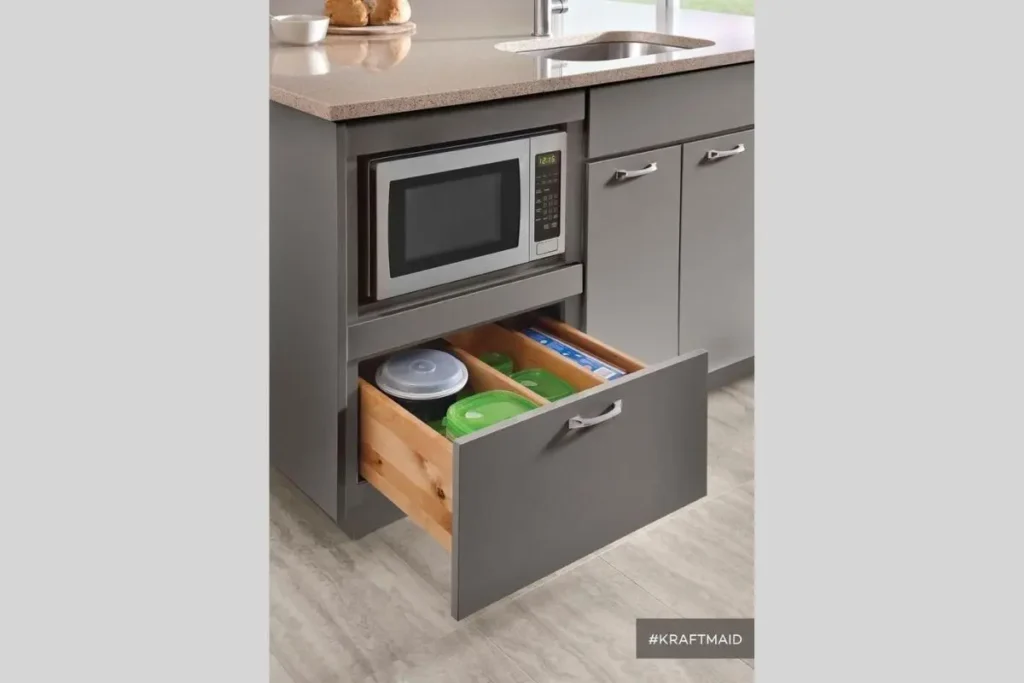
Kitchen design aesthetics are moving away from having eye-level appliances. If you are ready to sacrifice a lower storage cabinet, integrating the microwave under the counter is a sophisticated interior layout strategy that eliminates visual clutter.
The Conversion Process:
Door Removal: Remove the lower 24-inch base cabinet door and hinges.
- Electrical Access: You will likely need to drill a small 2-inch hole through the back or side of the cabinet interior to snake the power cord to the nearest grounded outlet (often used for a dishwasher or stove).
- Slide-In Placement: Place the microwave on the cabinet floor or on a reinforced pull-out drawer slide.
- Ergonomic Considerations: Lower placement means you will have to bend down to operate the keypad and monitor food. However, it is an incredibly safe height for lifting heavy, hot dishes, and it keeps the appliance completely hidden from the main line of sight.
Choosing the Right Hardware: Best Compact Microwaves & Stands for 2026
Pair your layout selection with sub-0.8 cubic foot compact models from reliable brands like Panasonic, Breville, COMFEE, Toshiba, GE, or LG to ensure a proper fit without bowing the surface.
Crucial Safety and Ventilation Clearances
Always maintain at least 3 inches of top clearance, 2 to 3 inches on the sides, and 1 to 2 inches at the rear to prevent magnetron overheating and fire risks.
Dedicated Outlets: Never plug a high-draw microwave into a standard power strip alongside other major appliances.
Optimizing your appliance setup is just one step in maximizing a compact home. To ensure that the rest of your space is equally functional, budget-friendly, and visually expansive, explore our foundational guide on simple kitchen design at low cost, where we break down complete zoning, lighting, and layout strategies for small houses.
Frequently Asked Questions (FAQs)
Where not to put your microwave in the kitchen?
Never place a microwave directly next to a sink, inside a totally enclosed cabinet without ventilation, or on an unstable surface.
Where to put a microwave in your kitchen in 2026?
Modern layouts prioritize rolling utility carts, heavy-duty wall brackets, and integrated lower cabinet cubbies.
How to hide a microwave in a small kitchen?
Remove a lower cabinet door to create a custom under-counter cubby, or place it on a rolling cart that can be tucked away.
Where are people putting their microwaves now?
Homeowners are moving toward dedicated appliance nook carts, under-cabinet floating shelves, and over-the-fridge vertical stacking.
Is it safe to put a microwave on top of a refrigerator?
Yes, if your refrigerator is at a safe height and you use a heat-resistant mat with 4 inches of top ventilation clearance.
Can I put a microwave inside a closed kitchen cabinet?
No, standard microwaves require constant airflow. Operating them behind closed doors traps heat and creates fire risks.

Ayesha Khan is a home stylist and interior layout strategist and the founder of Webpluse. She specializes in transforming compact residential spaces through practical apartment decorating ideas, high-density storage solutions, and budget-friendly home improvement strategies—all tested in her own rental apartments. Her guides help a global audience across the United States, France, and Germany furnish and style small spaces without overspending.